
Rummy vs Teen Patti: Cards, Deals and Decision Cycles
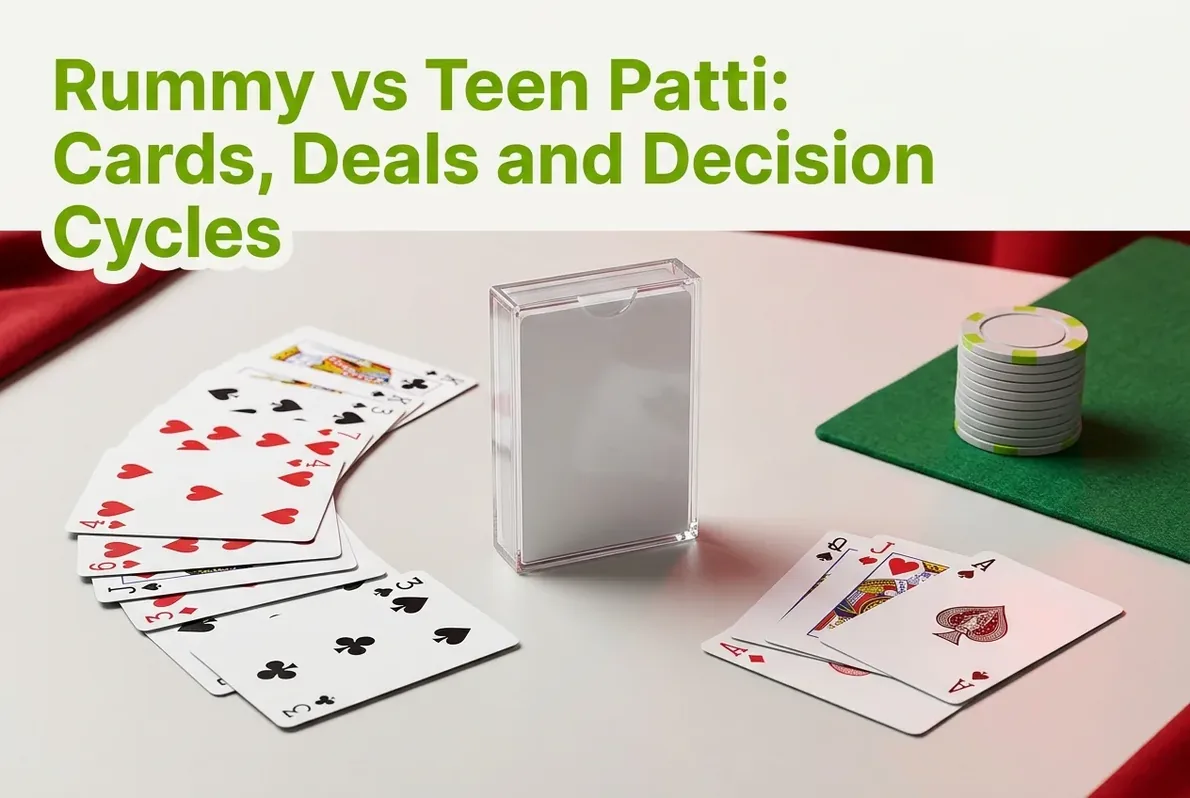
Rummy vs Teen Patti is a common comparison between two popular card games. In Rummy, each player receives thirteen cards and tries to form valid sequences and sets. The round ends when one player completes a hand. In Teen Patti, each player is dealt three cards and compares their hand to the others. The game includes betting rounds, and a player wins the pot either when cards are revealed or when all other players fold.
Core Comparison For New Players
New players consider Rummy and Teen Patti when choosing a card game. The structure of both games differs, and understanding the difference between Rummy and Teen Patti aids in decision-making.
| Rummy | Teen Patti |
|---|---|
| Skill based card melding game | Bet based hand comparing game |
| Two to six total players | Three to six total players |
| Complete all valid card melds | Hold the strongest three cards |
| Draws then discards one card | No further card draws occur |
| Betting stays rare during play | Betting occurs during every round |
| Hand resets after each round | Hand resets after each deal |
| Longer rounds span multiple turns | Shorter rounds finish much faster |
| Higher difficulty from card planning | Lower difficulty from quick bets |
Objectives And Winning Conditions

The Rummy vs Teen Patti game objectives guide every choice players make. Choices include opening draw, final bet, discard, raise, fold, or show. Players evaluate specific outcomes for their actions, and this evaluation turns random deals into strategic plans for future decisions. Each game sets its own win conditions:
- Rummy requires full meld;
- Two sequences, one pure;
- Valid declaration ends round;
- Invalid declaration adds penalty;
- Unmatched cards score points;
- Teen Patti ranks hand;
- Showdown compares active hands;
- Fold ends pot claim;
- Winner takes entire pot;
- Last player claims pot.
Cards Used And Dealing Methods
Deck composition and the Rummy vs Teen Patti number of cards both change the odds in these games. When players receive more or fewer cards, they find different combinations and notice each round moves at a different pace.
| Detail | Rummy | Teen Patti |
|---|---|---|
| Decks used | One or two decks | Single standard deck |
| Jokers or wilds | Printed joker plus wild card | No jokers used |
| Cards per player | Thirteen cards per player | Three cards per player |
| Dealing direction | Clockwise from dealer | Clockwise from dealer |
| Draw pile presence | Stock pile present | No draw pile |
| Discard pile visibility | Open discard pile visible | No discard pile |
| Ante requirement | No ante required | Ante placed at deal opening |
Turn Flow In Rummy
Players can plan their moves and monitor the cards as each round progresses. In Rummy, the turn order stays the same in every round. Each turn follows these steps:
- Draw choice. Choose a card from the stock or the discard pile.
- Meld formation. Place any complete sequences or sets face up after the draw.
- Hand reorganization. Arrange the remaining cards to find new combinations after the draw.
- Discard selection. Remove one card and place it on the discard pile.
- Declaration check. Declare the hand after all thirteen cards form valid combinations.
- Turn pass. Pass the turn to the next player in the fixed order.
Turn Flow In Teen Patti
In Teen Patti, all decisions occur in one betting round without draws or turns, which changes the Rummy vs Teen Patti turn structure and strategy. Each hand moves through these stages:
- Ante placement. Place the ante to open the pot.
- Card reception. Receive three concealed cards from the dealer.
- Initial decision. Review the hand and choose to continue or step aside.
- Calling. Match the current stake to remain active.
- Raising. Increase the stake to pressure rivals.
- Folding. Drop the hand and avoid further cost.
- Side-show request. Ask a neighbor to compare cards privately.
- Agreeing to show. Accept a direct comparison of hands.
- Pot award. Collect the pot after the final comparison.
Constructing Rummy Melds
In Teen Patti, each player is dealt three cards at the start, with no draws or trades afterward; hands are simply compared as dealt. In contrast, Rummy involves drawing and discarding cards each turn, focusing on building sequences and sets, so the game revolves around forming hands rather than relying solely on initial cards. Meld building follows these rules:
- Pure sequence excludes all jokers;
- Impure sequence allows joker substitution;
- Set requires three equal ranks;
- Joker fills any missing card;
- Minimum sequence length is three;
- High-card penalty raises unmatched points;
- Tight grouping reduces loose cards;
- Two sequences form common requirement;
- Declaration needs one pure sequence;
- Jokers cannot replace pure sequences.
Teen Patti Hand Rankings Explained
A player familiar with Rummy sequences and sets vs Teen Patti rankings can decide to bet again or to fold. Every three-card hand fits into a specific group. The outcome at the showdown depends on this ranking, which is the core of Rummy vs Teen Patti hand evaluation.
| Category | Description | Example |
|---|---|---|
| Trail | Three cards of exactly one rank | A♠ A♥ A♦ |
| Pure Sequence | Three consecutive cards of same suit | 5♣ 6♣ 7♣ |
| Sequence | Three consecutive cards of mixed suits | 8♠ 9♥ 10♦ |
| Color | Same suit but non consecutive cards | K♦ 8♦ 3♦ |
| Pair | Two equal ranks and one card | Q♠ Q♥ 5♣ |
| High Card | No matching pattern among any cards | A♠ J♦ 7♣ |
Scoring, Pots, And Penalties
Rummy and Teen Patti each have their own scoring systems. Rummy vs Teen Patti betting mechanics also set a different level of risk for players. Each game also tracks progress and the cost of a lost round in its own way.
| Rummy | Teen Patti |
|---|---|
| Unmatched cards add penalty points | Antes form the starting pot |
| Two sequences required, one pure | No sequence requirement exists |
| Face cards score ten points each | Bet increments raise the current stake |
| Valid declaration ends the round | Fold removes a player from the pot |
| Equal point totals split a loss | Identical hands split the pot |
| Points convert into a settlement value | Pot goes to the strongest remaining hand |
Probabilities Of Common Hands
Many people misunderstand strategies in Rummy and Teen Patti, as shown by the percentages. Players often misjudge how frequently certain deals occur, and their estimates differ from real outcomes.
| Hand Category | Approximate Probability | Frequency |
|---|---|---|
| Trail | 0,24% | One in 425 deals |
| Pure sequence | 0,22% | One in 460 deals |
| Sequence | 3,26% | One in 31 deals |
| Color | 4,96% | One in 20 deals |
| Pair | 16,94% | One in 6 deals |
| High card | 74,39% | One in 1 deal |
| Rummy combinations | Variable | Change with visible discards |
| Rummy sets | Variable | Depend on melds already shown |
Visible And Hidden Information
Rummy lets players see some cards and observe others' actions, while in Teen Patti, all cards stay hidden, requiring players to guess opponents' plans. This key difference influences how strategies are chosen and which tables players select each round. Players rely on these signals:
- Open discards show history;
- Shown melds reveal combos;
- Hidden hands stay unknown;
- Betting signals hint confidence;
- Seat order affects insight;
- Memory demands note ranks;
- Fold cue exposes weakness;
- Raise size projects strength;
- Card draws refresh outlook;
- Bet pattern tests resolve.
Skill, Luck, And Decision Quality
Both games combine skill and luck, and the Rummy vs Teen Patti skill vs luck balance starts with the cards players receive at the beginning. In Rummy, players select their moves throughout the game. In Teen Patti, players choose their actions during each betting round. Key skills in both games include:
- Card selection: Rummy players choose draws that complete pure sequences and sets quickly;
- Discard management: Rummy discards reveal information and limit opponents' winning options;
- Bet sizing: Teen Patti bets set pot pressure and signal real hand strength;
- Bluffing: Teen Patti bluffs disguise weak three-card hands from careful rivals;
- Fold timing: Teen Patti folds cut losses ahead of a costly final show;
- Probability use: Rummy and Teen Patti both reward probability-based decisions over blind guesswork.
Psychology, Myths, And Biases
Cognitive biases can distort judgment during card games. Players sometimes let earlier hands shape their next moves, even when probability shows a different choice makes sense. Common biases at the table include:
- Gambler's fallacy: a player expects a pure sequence after several weak Teen Patti deals;
- Hot-hand belief: a string of good discards feels like guaranteed Rummy melds ahead;
- Sunk-cost thinking: a player keeps calling bets to protect an already-lost Teen Patti pot;
- Recency bias: one recent trail outweighs the overall Teen Patti hand distribution;
- Overconfidence: a player overrates their ability to read a Rummy opponent's discard pattern;
- Confirmation bias: a player only notices signs that support an existing Teen Patti strategy.
Regional Rules And Variants
Rummy and Teen Patti each have a local version in India and Nepal. Rummy and Teen Patti also share the same structural contrast and construction against comparison, though the difference between them varies for every player across all variants.
| Game Variant | Rule Notes |
|---|---|
| Indian Rummy | 13 cards two pure sequences required for valid declare |
| Gin Rummy | 10 cards no joker used |
| Contract Rummy | hand size grows each round |
| Kalooki | 13 cards jokers add high value |
| Classic Teen Patti | three cards fixed boot amount |
| Muflis Teen Patti | three cards lowest hand wins |
| AK47 Teen Patti | three cards four wild ranks |
| Joker Teen Patti | three cards one random joker |
Practical Turn Examples For Beginners
Step-by-step examples guide players through a turn in Rummy and Teen Patti. Each example begins with the deal and continues through every stage until the round ends. Follow these steps:
- Drawing the card. The player takes a card from stock or discard.
- Checking the hand. The player searches for a possible set or sequence.
- Forming a meld. The player lays a complete set or sequence down.
- Discarding a card. The player drops one unwanted card and ends the turn.
- Posting the ante. Each player places a fixed amount into the pot.
- Viewing the hand. The player checks the three dealt cards in private.
- Calling or raising. The player matches the bet or raises it.
- Reaching the show. The higher hand among remaining players takes the pot.
Choosing Between The Two Games
Which is better, Rummy or Teen Patti, depends on preference. Each game rewards a different way of playing, so players can choose the one that fits their style. Consider these factors:
- Long planning: Rummy fits players who enjoy multi-turn card strategy and meld construction;
- Quick rounds: Teen Patti suits players who prefer fast three-card decisions;
- Social betting: Teen Patti appeals to players who enjoy group wagers at the table and raised tension;
- Probability interest: Rummy attracts players who track card odds across each draw;
- Budget control: Rummy helps players manage points and limit total card losses;
- Bluffing enjoyment: Teen Patti rewards players who value deceptive betting moves.
Conclusion
Rummy and Teen Patti both use playing cards but differ in objectives, turn order, and card rankings. In Rummy, players form sets or sequences and accumulate points over multiple turns. In Teen Patti, each player aims for the strongest three-card hand, with the winner determined by comparing these hands.
FAQ
Is Rummy Or Teen Patti Easier For Beginners?
Rummy appeals to players who like structure. The table shows every sequence and set. Teen Patti offers simple rules that are easy to learn. Players can call, raise, or fold.
What Is The Main Difference Between Rummy And Teen Patti?
Rummy and Teen Patti have different gameplay. Rummy involves building sequences and sets over many turns, with a focus on hand development. Teen Patti involves one three-card hand, and players compare hands through betting. The differences in gameplay shape the pace and strategy of each game.
How Many Cards Does Each Game Deal?
Gin Rummy deals 10 cards to each player. In Indian Rummy, each participant receives 13 cards. In Teen Patti, the dealer gives 3 cards to every player.