
Betting the Wheel: Roulette Neighbours, Call Bets, and Chip Layouts
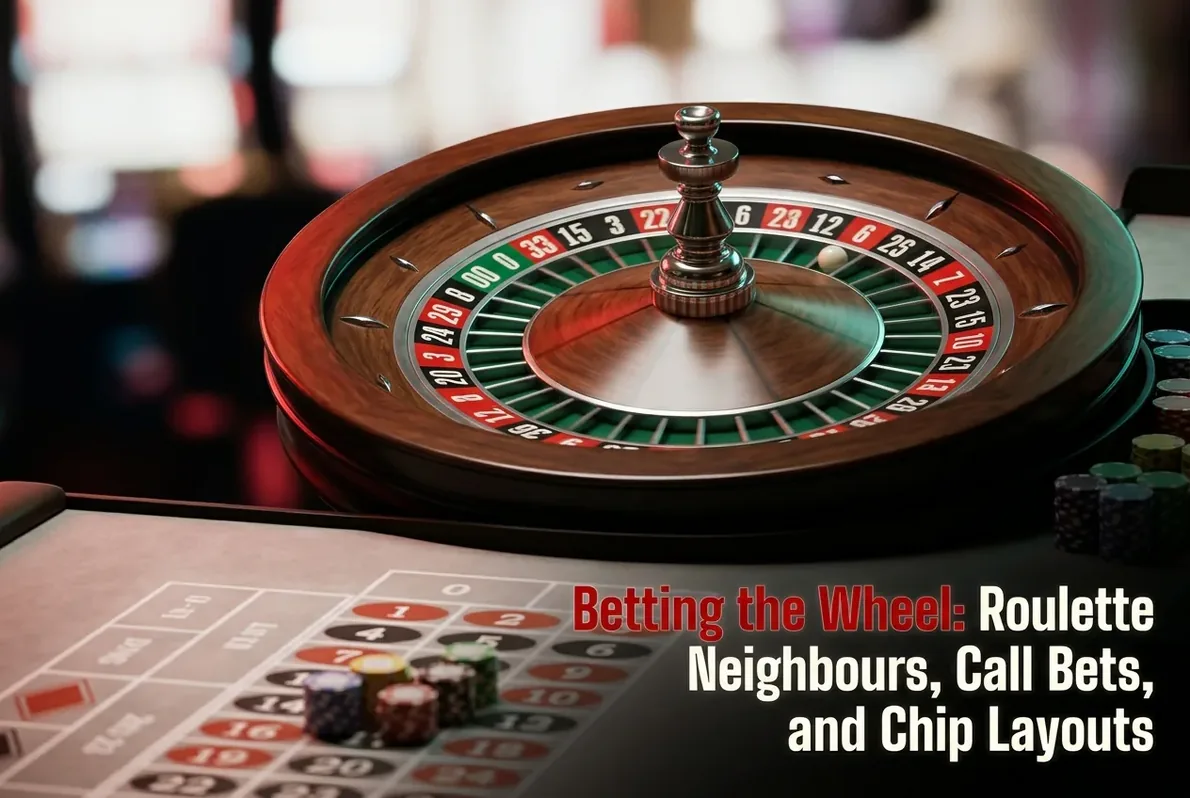
Roulette neighbours are bets placed on a group of pockets that sit next to each other on the wheel. A standard neighbour bet covers one chosen number plus the two pockets on each side of it, five numbers in total. Each of these numbers counts as a separate straight-up bet with its own chip.
Fundamental Overview Of Wheel Neighbors
Roulette groups numbers based on their positions on the wheel, and these groups form distinct patterns. Players receive the same return on group bets as on straight-up bets.
| Aspect | Detail |
|---|---|
| Definition | Pockets surrounding a chosen number |
| Pockets covered | Five consecutive wheel positions |
| Wheel sequence dependence | Follows physical wheel order |
| Typical chip count | One chip per pocket |
| Hit chance scaling | Rises with added neighbors |
| Payouts and odds | Standard house edge applies |
Target Readers And Learning Goals

Wheel-based bets attract players with very different backgrounds and goals. Understanding sector bets starts with a few core ideas: wheel order, pocket coverage, and probability. These concepts are especially useful for the following groups:
- New table players;
- Online roulette players;
- People curious about wheel sectors;
- People wanting to decode roulette neighbours;
- Those interested in probability and expected value;
- Readers drawn to myths around hot and cold numbers.
Physical Wheel Versus Table Grid
Roulette wheel numbers are arranged in a circular sequence. This order differs from the felt table grid, so each number has different neighbours on the wheel and on the grid. Chip placement shows the gap between these arrangements.
| Dimension | Wheel Order | Table Layout |
|---|---|---|
| Number ordering | Circular pocket sequence | Numerical rows columns |
| Definition of neighbors | Adjacent pockets on wheel | Adjacent numbers on grid |
| Splits and corners | Wheel proximity defines coverage | Table adjacency defines coverage |
| Chip scatter appearance | Scattered across felt | Clustered by number groups |
| Neighbor selection basis | Physical wheel position | Numerical table position |
European And American Wheel Layouts
There are two main types of roulette wheels: European and American. The difference between them affects both the odds and the house edge. The key differences are:
- Pocket count: 37 vs 38 total pockets;
- Zero configuration: single zero vs double zero;
- Single-number probability: 1/37 vs 1/38 chance;
- House edge values: 2.70% European vs 5.26% American;
- Call bets impact: double zero raises the roulette call bets house edge across all fixed sector arrangements.
Understanding The Wheel Number Sequence
The order of pockets on the wheel rim determines adjacent numbers. This order influences how roulette neighbour bets function. Adjacent numbers on European and American wheels differ, especially around the zero pockets.
| Wheel Segment | Note |
|---|---|
| 0 – 32 – 15 | Adjacent around zero |
| 26 – 0 – 32 | Zero sits between 26 and 32 |
| 10 – 5 – 24 | 10 and 11 are not adjacent |
| 00 – 27 – 10 | American wheel snippet |
Structure Of A Standard Neighbor Bet
A standard neighbor bet follows a five-pocket pattern centered on one selected number. The total stake and the coverage remain consistent regardless of the central number selected. The bet structure includes these elements:
- Central straight-up number: the selected wheel pocket receives one chip;
- Clockwise positions: the next two adjacent pockets on the wheel;
- Counterclockwise positions: the two pockets on the opposite side;
- One chip per pocket: each position carries one straight-up bet;
- Total stake size: five chips per spin;
- Coverage of 5/37 on European: the hit probability equals approximately 13.51%;
- Unchanged single-pocket probability: each pocket retains its original 1/37 probability.
Major Zero Sector Groupings On The Wheel
Dealers distribute chips across the table felt, following traditional zero-based sectors. These sectors divide the rim into groups for roulette racetrack call bets. The four main fixed sectors on a European wheel differ in position and chip count:
- Voisins du Zéro – 17 pockets around zero; needs 9 chips;
- Tiers du Cylindre – 12 pockets opposite zero; uses 6 chips;
- Orphelins – 8 pockets in two separate arc gaps; needs 5 chips;
- Jeu Zéro – 7 pockets close to zero; uses 4 chips.
Voisins Du Zero Sector Details
On a European wheel, the zero sector covers 17 consecutive pockets, including the green zero. Players spread chips across several bet types to cover the whole arc.
| Detail | Data |
|---|---|
| Wheel span | 17 pockets total |
| Numbers in order | 22 18 29 7 28 12 35 3 26 0 32 15 19 4 21 2 25 |
| Trio bet | 0 2 3 two chips |
| Split bets | Five splits one chip each |
| Corner bet | 25 26 28 29 two chips |
| Total chips | 9 chips placed |
| Hit probability | 17/37 approx 45.95% |
| Hit distribution | Uneven by bet type |
Tiers Du Cylindre Sector Details
Tiers du Cylindre refers to the wheel arc opposite the Voisins du Zéro section. This segment contains twelve consecutive pockets. The main characteristics of this bet are:
- Covered numbers: 5, 8, 10, 11, 13, 16, 23, 24, 27, 30, 33, 36;
- Rim position: opposite zero arc;
- Chip structure: six split chips only;
- Hit rate: 12/37, roughly 32.43%;
- Coverage profile: leaner coverage than the 17-pocket zero sector produces a sharper risk-return profile.
Orphelins And Jeu Zero Explained
Two sectors are positioned between the wheel areas. Each sector covers specific wheel pockets and operates with its assigned number of chips.
| Feature | Orphelins | Jeu Zero |
|---|---|---|
| Numbers covered | 1, 6, 9, 14, 17, 20, 31, 34 | 12, 35, 3, 26, 0, 32, 15 |
| Chip count | 5 chips | 4 chips |
| Main bet types | Straight-up and split bets | Straight-up and split bets |
| Approximate hit chance | 21.62% (8/37) | 18.92% (7/37) |
| Relationship to other sectors | Outside Voisins and Tiers | Fully inside Voisins |
Chip Placement For Fixed Call Patterns
Chip spots for patterns are placed on the table. Each spot corresponds to the chip layout used for a roulette neighbour bet. European roulette uses four fixed call patterns. Each pattern requires the following bets and chips:
- Voisins du Zéro: 1 trio (2 chips), 1 corner (2 chips), 5 splits, 9 chips total;
- Tiers du Cylindre: 0 trios, 0 corners, 6 splits, 6 chips total;
- Orphelins: 0 trios, 0 corners, 4 splits, 1 straight, 5 chips total;
- Jeu Zéro: 0 trios, 0 corners, 3 splits, 1 straight, 4 chips total.
Announced Roulette Call Procedures
At a roulette table, players call out their racetrack bets. The dealer hears these bets and places the chips on the spots on the layout. Follow these steps to place a call bet:
- Declare the pattern and stake: name the sector or central number and state the total chip amount.
- Listen for the dealer repeat: wait for the dealer to confirm the requested sector back to the table.
- Watch the dealer place chips: observe the dealer set internal chips across the specified table positions.
- Confirm the bet at the last-call moment: confirm no changes are needed at the last-call moment.
- Collect winnings or accept the loss: the dealer updates all balances accordingly.
Probabilities For Neighbor And Sector Selections
Placing call bets on more positions increases the chance of winning. Still, each spin has a negative expectation, and the house edge stays the same no matter how many positions are covered.
| Bet Pattern | Pockets Covered | Approximate Probability |
|---|---|---|
| Single number | 1 | 2.70% |
| Five-number neighbour | 5 | 13.51% |
| Voisins du Zéro | 17 | 45.95% |
| Tiers du Cylindre | 12 | 32.43% |
| Orphelins | 8 | 21.62% |
| Jeu Zéro | 7 | 18.92% |
House Edge For Different Roulette Types
Straight-up bets inside neighbour and sector patterns pay a fixed 35 to 1. The house edge depends only on the wheel type and applies equally to all neighbour and sector selections. The main figures are:
- European wheel edge: 2.70%;
- American wheel edge: 5.26%;
- Sector and neighbour bets: identical edge to straight bets;
- Changing layouts: does not alter expected loss.
Myths Around Hot And Cold Results
Some players notice certain pockets appearing more frequently. When they see a streak, they take it as evidence for this belief. These ideas influence how bettors choose sector bets, although each spin remains independent. The most common myths are:
- Gambler's fallacy: overdue number expected;
- Hot-hand belief: recent wins predict continuation;
- Short-term variance: misread as a pattern;
- Sector bias: watched area feels "due";
- Cold number avoidance: low frequency signals future absence.
Psychology Behind Wheel Sector Choices
Cognitive biases influence the way people make decisions. At the table, players tend to choose sectors because they notice patterns, act out of habit, or respond to immediate feelings. Few rely on math when making their selections. Choices are usually shaped by emotion and routine.
| Cognitive Factor | Effect on Sector Choice |
|---|---|
| Visual grouping | Sectors feel naturally connected |
| Perceived coverage | More pockets feel safer |
| Near-miss impact | Close results extend sessions |
| Selective memory | Wins recalled over losses |
| Sense of control | Sector choice feels strategic |
Worked Example Of A Neighbor Calculation
A neighbour bet works the same way regardless of the chosen central number. A neighbour bet includes five pockets in all, focusing on the pockets surrounding a single number on a European roulette wheel. The probability of winning takes only a few steps to calculate:
- Choose a central number: select pocket 0 on a European wheel.
- Locate adjacent pockets: find the two pockets on each side of 0 in wheel order.
- List all five pockets: record 3, 26, 0, 32, and 15.
- Compute hit probability: divide 5 by 37 to get approximately 13.51 percent.
- Identify the miss probability: note that 32 out of 37 spins produce no payout.
- Note negative expectation: standard 35-to-1 payouts do not offset the house edge.
Conclusion
Roulette neighbours are named for their positions on the wheel, with fixed sector patterns showing how many pockets each call bet covers. The probability and house edge remain unchanged regardless of sector size or selection method.
FAQ
How Are Wheel Sectors Different From Felt Areas?
Wheel pockets follow the sequence set by the wheel rim. The table displays the numbers in a different order. This distinction is important when players place roulette bets.
What Odds Do Sector Patterns Typically Offer?
The odds in each sector change based on how many pockets the bet covers. When someone picks a sector, the chance to win goes up. Still, the odds and payouts for roulette neighbours bets give the house an advantage on every spin.
Do Named Call Patterns Improve Long Term Results?
Named sectors provide coverage options on the roulette wheel, allowing players to bet on specific sections. Voisins, Tiers, Orphelins, and Jeu Zéro are examples of these named sectors. The house edge for call bets remains constant, as it is influenced by the number of green pockets on the wheel.