
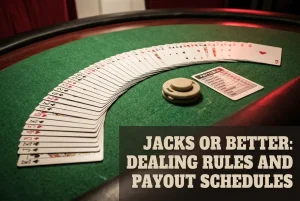
Jacks or Better: Dealing Rules and Payout SchedulesNew!!
Jacks or Better is a five-card draw video poker format built on a fixed paytable and a standard 52-card deck. Find out how to play Jacks or Better across every key area: the dealing and draw rules, hand rankings, paytable structures, optimal card-holding strategy, probability and expected return, and the behavioral psychology that shapes decisions […]
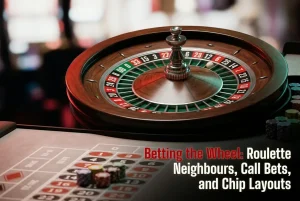
Betting the Wheel: Roulette Neighbours, Call Bets, and Chip LayoutsNew!!
Roulette neighbours are bets placed on a group of pockets that sit next to each other on the wheel. A standard neighbour bet covers one chosen number plus the two pockets on each side of it, five numbers in total. Each of these numbers counts as a separate straight-up bet with its own chip. Fundamental […]
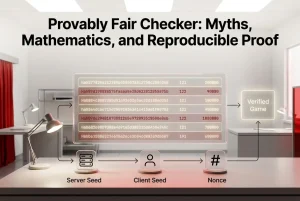
Provably Fair Checker: Myths, Mathematics, and Reproducible ProofNew!!
A provably fair checker allows players to independently audit casino game outcomes. It requires the server seed, client seed, and nonces from completed betting rounds. Players can confirm game integrity through verifiable calculation. Provably fair systems use cryptographic commitment and transparent algorithms. Players can audit past games independently of casino claims. Provably fair systems differ […]
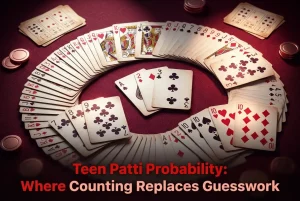
Teen Patti Probability: Where Counting Replaces GuessworkNew!!
Teen Patti probability focuses on counting three-card combinations from a 52-card deck, yielding 22,100 possible hands. Each hand has equal mathematical weight, which removes guesswork from analysis. Measurable odds and exact category frequencies define each hand rank. Combination mathematics is used to analyze myths about betting decisions, as well as the psychology of selective memory. […]

Teen Patti Rules For Ante, Betting, And Final ShowdownNew!!
A solid grasp of Teen Pattii rules gives any new player a strong starting point. This guide focuses on the core Teen Patti rules for beginners, covering betting order, hand rankings, and key mathematical concepts. Probability myths are also examined, so readers can separate factual game structure from common misconceptions before they sit down at […]
Gambler's Fallacy: Why Probability Has No Memory of LossesNew!!
The gambler's fallacy is the belief that a run of losses brings a win closer. In games with independent rounds, every result draws on the same fixed odds. A loss never raises the chance of winning on the next round, because probability keeps no record of earlier outcomes. Basic Mechanics Of Gambling Misconceptions Many gambling […]