Provably Fair Checker: Myths, Mathematics, and Reproducible Proof
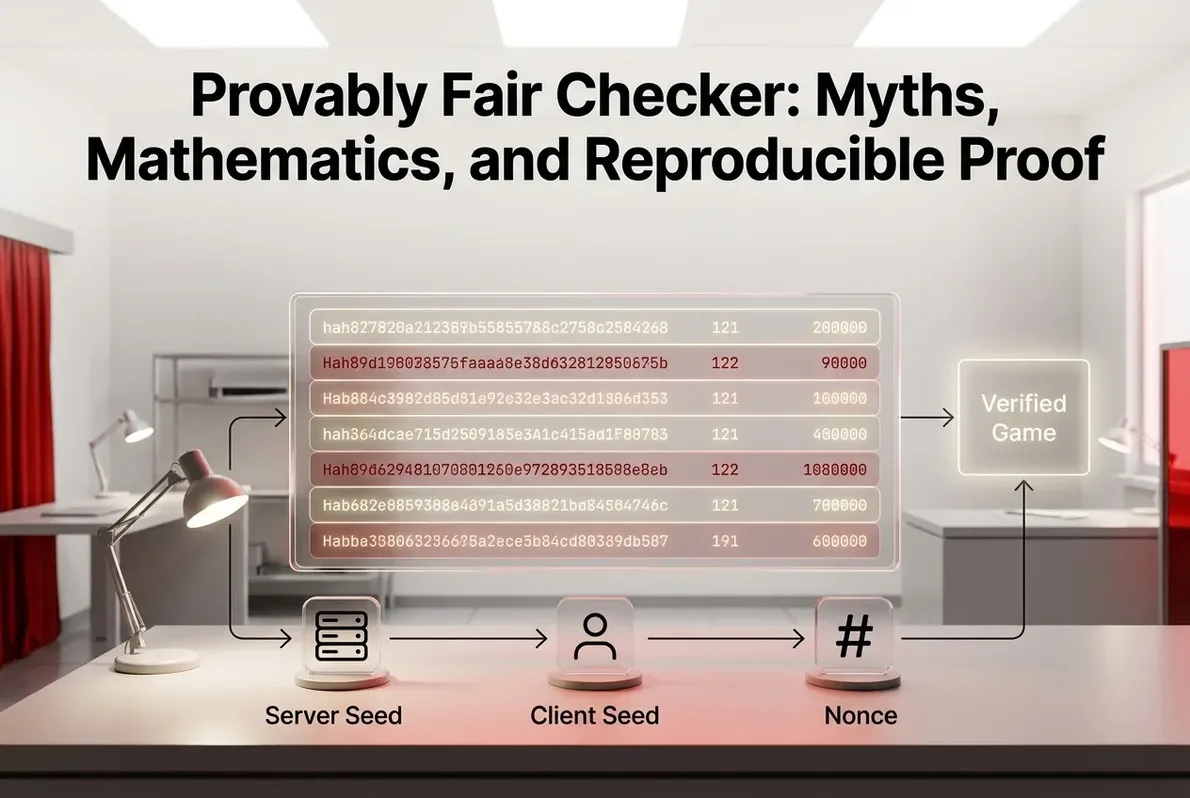
A provably fair checker allows players to independently audit casino game outcomes. It requires the server seed, client seed, and nonces from completed betting rounds. Players can confirm game integrity through verifiable calculation. Provably fair systems use cryptographic commitment and transparent algorithms. Players can audit past games independently of casino claims. Provably fair systems differ from RNG systems that use internal software randomness. Providers like BGaming implement provably fair technology with cryptographic proof. Outcomes in provably fair systems are determined before bets are placed and can be verified afterward.
Core Mechanics Of Provable Fairness
Provable fairness uses cryptographic commitment, player input, and deterministic algorithms. The server and client seeds combine for each calculation, and players can independently repeat and verify it.
| Aspect | Description |
|---|---|
| Server seed role | Casino-generated secret key |
| Client seed role | Player-supplied calculation input |
| Nonce purpose | Unique per-bet counter |
| Commitment hash | SHA-256 of server seed |
| Reveal step | Seed disclosed after round |
| HMAC function | Keyed deterministic hash output |
| Conversion formula | Hash mapped to result |
| Verification goal | Reproduce published round outcome |
Who Uses A Provably Fair Checker
Several distinct user categories rely on verification tools. A provably fair checker serves casino players and independent analysts, who use the tool for factual verification and mathematical confirmation. Players prefer reproducible results over assumptions. The main user groups include:
- Casual slot players;
- High-stakes table users;
- Mathematically curious players;
- Independent auditors;
- Crypto casino participants;
- Dispute investigators;
- Game formula researchers;
- Seed transparency advocates.
Defining Provable Fairness In Casino Mathematics
In casino mathematics, SHA256 hash verification follows a commit-and-reveal structure. At the beginning of each round, the casino supplies a cryptographic input. This input sets the outcome.
| Concept | Practical Detail |
|---|---|
| Commitment | Pre-game hash |
| Determinism | Same inputs, same result |
| One-way hashing | No reverse seed |
| Auditability | Player-side recomputation |
| Key | Server seed in HMAC |
| Message | Client seed and nonce combined |
| Output | 64-character hexadecimal string |
| Conversion | Hash mapped to a game value |
Server Seed Creation And Hash Commitment
Before any player places a bet, the casino generates the server seed. Staff secure this value using a SHA-256 hash, then publish the hash for public reference. Players can verify the hash to confirm the casino's commitment. This method prevents tampering, as any change to the server seed becomes immediately visible to players. The server seed and the client seed together form a pair of inputs. The server seed has these properties:
- High-entropy random source;
- Kept secret until reveal;
- SHA-256 hash outputs 64 characters;
- Case-sensitive seed text;
- Tiny changes, new hash;
- One seed per session;
- Revealed only post-round.
Client Seed And Player Control
The client seed is a value provided by the player to the algorithm. Before the game begins, the player can review or choose this value. To verify a fair round, the player must use the same client seed. The casino stores the client seed with the bet record and can retrieve it if necessary. A third-party checker tool also requires the client seed, as it uses this value to perform the calculations again. The client seed follows these rules:
- Player-chosen text string;
- Stored with bet record;
- Affects HMAC message;
- Exact spelling required;
- Spaces alter output;
- Punctuation changes hash;
- Invalidated by edits;
- Limits one-sided selection.
Nonce And Round Identification
Each bet receives a unique nonce, which is an incrementing number used as a counter in fair algorithms. The nonce keeps every round separate, and seeds do not connect one round to another. So each bet outcome remains independent. Key nonce properties include:
- Starts from zero or one;
- Increments every bet;
- Tied to bet history;
- Prevents duplicate input messages;
- Wrong nonce, wrong result;
- Shared seeds, distinct numbers;
- Defined by game documentation.
How HMAC SHA256 Generates Deterministic Values
Third party provably fair checker tools can replicate HMAC-SHA256, which combines a secret server seed with a public message. The public message contains the client seed and the nonce. The same inputs always produce the same 256-bit output.
| Component | Value |
|---|---|
| Key | Server seed text |
| Message | Client seed and nonce combined |
| Encoding | UTF-8 text bytes |
| Output length | 64 hexadecimal characters |
| Bit depth | 256 bits |
| Determinism | Same inputs produce same hex |
| Replication | External tools reproduce the result |
From Hexadecimal Hash To Game Result
The raw HMAC output is a string made up of hexadecimal characters. Crash and dice games apply this string in their specific formulas. Each game type uses its own process to convert the string into an outcome, with formulas for each game type following distinct steps. Common conversion operations include:
- Take the first N bytes;
- Convert hex to integer;
- Apply modulo to range;
- Use rejection sampling;
- Scale to multiplier (crash);
- Map to roll interval (dice);
- Discard out-of-range values;
- Round to displayed precision.
Step By Step Round Verification Instructions
Each completed round follows the same sequence of actions. To verify a provably fair round, copy all recorded inputs and recompute the relevant hashes. Compare the reproduced outcome against the round history. Every character in each field must match exactly. The process is deterministic and fully reproducible. Follow these steps:
- Open the fairness page. Go to the history or fairness panel and locate the completed round.
- Copy the commitment hash. Take the original server-seed hash recorded at commitment time.
- Retrieve the revealed server seed. Take the exact seed the site published after the round ended.
- Record the client seed. Take the player-side seed recorded for that round.
- Note the nonce. Take the exact round counter number shown in the bet history.
- Paste all values into the checker. Enter each field without extra spaces or altered characters.
- Run the hash comparison. Let the checker hash the revealed seed and compare it to the commitment.
- Compare the computed result. Check the checker's output against the displayed round result.
Required Inputs For Any Provably Fair Checker
A third party checker tool must have all relevant input fields documented and available. A complete record is necessary for external tools to reproduce the original calculation. Each input listed is necessary for independent confirmation. Missing one value disrupts the verification chain. A complete record includes:
- Revealed server seed;
- Original commitment hash;
- Client seed string;
- Nonce or round counter;
- Game identifier;
- Conversion formula version;
- Optional round index or cursor;
- Byte selection rule.
Comparing Results Between Different Checker Tools
Results verified using several independent tools carry stronger mathematical support than those checked by a single source. Comparing calculations across multiple tools allows confirmation that the numbers align. It also shows whether the implementation details adhere to the published rules. Use this checklist for cross-tool comparison:
- Use identical input values;
- Check intermediate hashes;
- Note rounding behavior;
- Confirm same final result;
- Investigate any discrepancy;
- Match delimiter formats;
- Verify byte-selection rules;
- Record every tool's output.
What Does A Matching Hash Demonstrate
In casino environments, SHA256 hash verification relies on a single mathematical rule. The digest function produces a 64-character output for every input. The administrator demonstrates that the SHA-256 digest generated from the disclosed server seed matches the original commitment hash. This process lets users confirm that the seed remained unchanged after the commitment. A matching hash shows:
- Same seed, same hash;
- Commitment fixed before play;
- No post-game reseeding;
- Deterministic digest behavior;
- Seed integrity confirmed;
- One-way function applied;
- Input unchanged throughout.
What Does A Matching Outcome Confirm
Provably fair verification relies on a single main idea: players repeat the calculation themselves to check if their result matches the recorded outcome. This method does not verify payouts or confirm the final result. Instead, it confirms the underlying math is accurate. If the player's calculation produces the same outcome as the record, the system validates that outcome. A matching outcome confirms:
- Algorithm used as published;
- Inputs recorded accurately;
- Conversion formula reproducible;
- Round independently verifiable;
- No hidden adjustments;
- Nonce correctly identified;
- Output deterministically produced.
What Does Failed Verification Indicate
Several distinct causes explain a failed check. A mismatch between recomputed and recorded values often results from data entry mistakes or undocumented parameters. A discrepancy necessitates a full review of every input. Persistent unexplained failures raise questions about manipulation of provably fair games. Failure alone does not prove manipulation but requires investigation. Common causes of a failed check include:
- Copied wrong server seed;
- Different client seed used;
- Incorrect nonce value;
- Different hash algorithm applied;
- Outdated conversion rules followed;
- Round index omitted entirely;
- Message delimiter format wrong;
- Commitment belongs to another session;
- Displayed result recorded incorrectly.
Why Identical Seeds Cannot Repeat Automatically
The nonce changes with every round, and each nonce produces a unique HMAC input. Different nonce values result in different messages, so the HMAC-SHA256 output changes entirely with each new nonce. The same seed pair can be reused across rounds without repeating results. Independence of results comes from these technical reasons:
- Nonce increments each round;
- HMAC message always unique;
- Seed pair reused safely;
- No automatic repetition;
- Key and message stay distinct;
- Each round input differs;
- Sequence never loops mechanically;
- Independent outputs guaranteed by design.
Can Provably Fair Games Be Manipulated
Cryptographic proofs block post-round seed substitution in provably fair games. These proofs do not change the house edge in the conversion formula. Using a provably fair checker can reveal hidden outcome tampering in specific completed rounds. Verification has these boundaries and limitations:
- Cannot change committed seed;
- House edge still present;
- Biased formulas remain possible;
- Checkers expose inconsistencies;
- Transparency reduces suspicion;
- Verification is round-specific;
- Odds stay fixed regardless.
Probability And Randomness In Individual Rounds
Provably fair crash and dice games use verified random processes to determine outcomes, which naturally create streaks and clusters. A series of losses does not mean manipulation, nor do runs of high multipliers mean favoritism. Verification confirms how results are calculated, but it does not alter the underlying distribution of outcomes.
| Myth | Probability Fact |
|---|---|
| A loss streak must end soon | Each round is independent |
| A high multiplier is now due | The same odds apply every time |
| Consecutive dice losses indicate bias | Random sequences form clusters naturally |
| A winning run confirms a pattern | Short runs carry no predictive weight |
| Verified rounds guarantee fair outcomes ahead | Verification covers past inputs only |
| A crash at 1x makes a high multiplier next more probable | No round retains memory of prior results |
| Frequent low dice rolls signal tampering | Low results group by chance alone |
Behavioral Biases In Verified Result Interpretation
Mental habits influence how players interpret data. Players often misread sequences, as their tendencies affect what they notice. They tend to see patterns in random variation and draw conclusions that lack support. The most common biases include:
- Gambler's fallacy – expects a streak to self-correct;
- Recency weighting of outcomes – overvalues the last few results;
- Hot-hand belief – infers a winning trend from short runs;
- Confirmation bias – recalls only results that fit expectations;
- Near-miss overemphasis – assigns statistical meaning to close results;
- Loss attribution error – interprets a long losing run as deliberate targeting.
Practical Dice Verification Example
A dice round can be verified with the values alpha-example-seed, player-example, and nonce 17. Anyone can follow these steps to obtain the same result, and any checker can be used to achieve the result. Follow these steps:
- Copy the server seed. Take the full revealed server seed: alpha-example-seed.
- Compute its SHA-256. Run the seed through SHA-256 to produce the commitment hash.
- Compare commitment hashes. Match the computed hash against the originally published hash.
- Form the HMAC message. Combine the client seed and nonce into player-example:17.
- Apply the HMAC-SHA256 key. Use alpha-example-seed for the key.
- Record the hex output. Copy the full 64-character hexadecimal result.
- Convert hex to a number. Extract the relevant characters and convert them to a decimal integer.
- Apply the dice mapping. Run the documented range formula to produce the final dice value and check it against the recorded roll.
Practical Crash Verification Example
Crash games rely on a cryptographic structure similar to that used in dice rounds. A formula processes the hash output to generate a multiplier. Every stage in this sequence is recorded. Players are given the inputs, allowing them to reconstruct the value presented. Follow these steps:
- Fetch all inputs. Collect the server seed, client seed, and nonce from the round record.
- Compute the HMAC. Run HMAC-SHA256 with the server seed for the key and clientSeed:nonce as the message.
- Extract the required bytes. Take the first 8 hexadecimal characters from the output.
- Convert to an integer. Parse those characters into a base-16 number.
- Derive a fractional value. Divide that integer by its maximum possible value.
- Apply the multiplier formula. Insert the fraction into the documented crash multiplier equation.
- Round the result. Follow the game's stated decimal-precision rule.
- Match the history. Compare the calculated multiplier against the displayed round record.
Can Past Verified Rounds Predict Anything
Each round begins with specific inputs. The commitment hash conceals the seed, and cryptographic hash functions are one-way processes that cannot be reversed. Streak-based predictions are unreliable. An individual reviews the outcome at the end of the round. Verified history shows the following:
- Commitment hides server seed;
- New seeds replace revealed ones;
- Past losses change nothing;
- Past wins change nothing;
- Independent rounds share no memory;
- Hash functions block reverse calculations;
- History confirms inputs, not forecasts;
- Use checking, not forecasting.
Conclusion
A provably fair checker confirms a completed round ran on its documented algorithm. It separates mathematical reality from common myths about streaks and patterns. It does not promise profit and does not alter stated odds.
FAQ
How Does A Provably Fair Checker Work?
The checker receives the published server seeds, client seeds, and nonces, recalculates the hashes and results, and compares them to the recorded game history to confirm the round followed the algorithm.
Why Use A Provably Fair Checker?
Players use tools to verify that outcomes result from seeds and rules. People build trust by relying on calculation rather than belief.
Can A Provably Fair Checker Predict Future Rounds?
Commitment hashes conceal the original seeds. Verification tools examine only the rounds that an individual has completed. Each time the system introduces a new seed or nonce, it generates a different random result.